Over the past few posts, I’ve shared some of my wrestling with faith and the Berean Framework that grew out of it.
That wrestling helped me recognize how much we need wisdom, discernment, and Christlike character when we face difficult questions or situations—and how much time and practice those qualities take to develop.
They grow through our everyday walk with Christ—learning His Word, practicing obedience, receiving correction, and learning to love people well.
🌱 Those small acts of daily faithfulness matter. We cannot wait until a difficult situation calls for wisdom and discernment to begin cultivating them.
Spiritual growth is not automatic. While God is the One who transforms us, growing toward maturity requires our cooperation—responding to Him and participating intentionally in His work.
Scripture describes that growth as moving from milk to solid food. We are meant to grow beyond the basics of the faith toward deeper understanding and mature discernment.
Hebrews 5:14 (NIV) connects that maturity with practice:
“But solid food is for the mature, who by constant use have trained themselves to distinguish good from evil.”
🌱 We have to get our reps in.
Each act of obedience, each willingness to receive correction, each choice to love well is an opportunity to practice what we believe.
That practiced discernment is part of God’s larger purpose for us: to be “conformed to the image of his Son” (Romans 8:29 NIV)
—becoming more like Christ in how we think, love, and live.
That desire to help people grow is part of what led me this past spring to begin The Suede Sofa Podcast.
Not because I have discipleship figured out.
I definitely do not. 😅
I’m a fellow disciple who has spent years walking with Christ—studying, praying, wrestling, learning from others, and making plenty of mistakes.
More recently, I’ve been putting language and frameworks around some of what I’ve learned. Through that work, I’ve developed a practical discipleship pathway that builds on foundations of faith and explores understanding, discernment, and faithful living—bringing together lessons I wish I had understood sooner and tools to help put them into practice.
There are many helpful resources out there for growing in Christ. My hope is that this pathway will be helpful too, alongside the discipleship happening in your local church.
My hope is to walk alongside people who want to:
➡️ Know Christ more deeply and understand His Word ➡️ Grow in wisdom and discernment ➡️ Mature in character, assignment, and craft ➡️ Love God and people well ➡️ Remain faithful for the long haul
To keep becoming more like Christ. And ultimately, to:
F i n i s h w e l l .
As I share this, I do so as a fellow disciple, not a theologian or Bible scholar—offering what I’ve learned and am continuing to learn as I walk with Christ.
This podcast is part of faithful stewardship for me in this season, with the hope that those lessons may help others along the way.
I share this with humility, knowing I still have much to learn, and with open hands, trusting God with the outcome.
If that sounds like a journey you’d like to take with me, I would love to have you join me.
🎙️ The Suede Sofa Podcast The first episode is here. 👇
Every day, we encounter ideas and claims about God, people, truth, culture, and how we should live. Many of those claims contradict one another. To keep from being tossed back and forth by competing ideas, teachings, and worldviews, we need to know what we believe, why we believe it, and how we discern what is true. (See Ephesians 4:14.)
Seeking truth requires both conviction and humility. Not every question is equally clear, and faithful Christians sometimes come to different conclusions—including about the relationship among Scripture, church authority, and tradition. I want to hold my own convictions with humility and respect those who understand these things differently.
For me, discernment begins here: Jesus Christ is Lord, and I look to Scripture as the final authority by which I test what I hear and discern how I am called to live.
But final authority does not mean discerning or growing in isolation. Christ has given shepherds and teachers to equip His people, and I believe He designed Christian growth to take place within the body of Christ—in the local church, in community with other believers, and with the help of faithful leaders who can instruct, challenge, encourage, and correct us.
As I have tried to live out those convictions more faithfully, I have wanted a practical way to cut through the surrounding noise, return to central biblical principles, and think more clearly about what I hear.
The Berean Framework grew out of that need.
I do not offer the Berean Framework as an authority or a theological system. It is simply a practical tool that has helped me approach discernment with humility, wisdom, and personal responsibility—and I hope it may help others too.
If you share some of these convictions—and have wanted a practical way to better live them out amid all the competing voices—the Berean Framework may be helpful to you.
═════════════════════════
📖 THE BEREAN POSTURE
═════════════════════════
The name comes from Acts 17:11:
“The Berean Jews…received the message with great eagerness and examined the Scriptures every day to see if what Paul said was true.” —Acts 17:11 NIV
The Bereans did two things at once:
1️⃣ They received eagerly. 2️⃣ They examined carefully.
Their example gives us a helpful posture for discernment:
✅ Open—but not gullible. ✅ Discerning—but not cynical.
They did not reject the message simply because it was new to them, but neither did they accept it merely because a respected teacher delivered it.
They received the message eagerly while testing what they heard against Scripture.
That is the posture of the Berean Framework:
✅ Receive humbly. ✅ Examine carefully. ✅ Stay teachable. ✅ Search Scripture. ✅ Keep the whole counsel of God in view. ✅ Allow the truth to form you.
The goal is not merely to decide whether someone else is right or wrong.
The goal is to become people who can think biblically, discern wisely, love faithfully, and remain rooted in Christ—whatever the next moment brings.
That means we do not reserve discernment only for voices outside our circles. We also test what we hear from the teachers, leaders, traditions, and voices we know and respect.
And yes, that includes anything I share here. 🔎
═════════════════════════
💪 DISCERNMENT CANNOT BE OUTSOURCED
═════════════════════════
We can—and should—learn from wise teachers. But they cannot take our place in the work of learning, testing, obeying, and allowing the truth to form us.
You’ll hear me say this often:
💪 No one else can do your push-ups for you. 💪
Discernment grows within the body of Christ, with the help of wise teachers and other believers—but it remains a personal responsibility. Each of us must learn to test what we hear and respond faithfully.
═════════════════════════
🔎 QUESTIONS THAT HELP US EXAMINE THE MESSAGE
═════════════════════════
🔹 Is it faithful to Scripture?
🔹 Am I understanding the text in context?
🔹 Does it fit with the whole counsel of God?
🔹 What does Scripture make clear—and where do I need humility about what I do not know?
🔹 Is this a central Christian truth—or a secondary issue on which faithful Christians may disagree?
🔹 What kind of fruit does this teaching tend to produce?
═════════════════════════
🪞 QUESTIONS THAT ALLOW THE TRUTH TO EXAMINE US
═════════════════════════
🔹 Am I accepting or rejecting this because I like—or dislike—what it says?
🔹 Am I testing this fairly, or merely looking for something wrong with the person saying it?
🔹 Am I willing to reconsider something I already believe?
🔹 Am I humble enough to be corrected if I am wrong?
🔹 Am I willing to be formed by what is true?
═════════════════════════
🚧 KEEPING GRACE AND TRUTH TOGETHER
═════════════════════════
Discernment is not only about reaching the right conclusion. We also want the way we speak and respond to reflect Christ.
As I have practiced discernment, there are two recurring ditches I am learning to watch for:
🚧 DITCH #1: TRUTH HANDLED WITHOUT GRACE
We may defend something that is true—or one part of the truth—while losing sight of the whole counsel of God. Detached from grace, humility, and love, even truth can be handled in ways that become harsh, proud, suspicious, or more interested in condemning people than restoring them. We can become so focused on correcting what is wrong that we forget we are speaking to—or about—someone who bears the image of God.
🚧 DITCH #2: GRACE DETACHED FROM TRUTH
We may emphasize compassion, kindness, or acceptance while giving too little attention to truth, repentance, and obedience. What appears gracious can cease to be truly gracious when it leaves no room for these things. Biblical grace does not merely comfort or welcome us; it also trains us “to live self-controlled, upright and godly lives” (Titus 2:11–12).
🚧🚧 Neither ditch reflects Christ.
Jesus was full of grace and truth. That is the pattern I want to keep in view:
“The Word became flesh and made his dwelling among us…. We have seen his glory…full of grace and truth.” —John 1:14 NIV
═════════════════════════
⚖️ CONSISTENCY CHECK
═════════════════════════
A helpful consistency check is to ask whether our standard changes depending on the person, group, or situation we are evaluating.
Tribal loyalty—especially when reinforced by an echo chamber—can lead us to apply truth without grace to people outside our circle while offering grace detached from truth to the people, teachers, leaders, movements, or traditions we identify with.
We scrutinize opponents while excusing allies.
But biblical discernment does not change its standard depending on whose beliefs, words, or behavior we are evaluating. Our highest allegiance belongs to Christ—not to a personality, platform, church, movement, or tribe.
True discernment applies the same standard to our own beliefs and conclusions that it applies to those of others. It does not merely identify error elsewhere; it allows the truth to examine and form us too.
The Berean Framework is one method—a practical tool, not the standard or the destination.
At the center of all this is not a framework—or even a principle—but a Person: Jesus Christ.
Scripture is the standard. The framework is simply a tool intended to help us follow Him more faithfully—with humility, wisdom, grace, and truth.
Yesterday, I shared that stewardship is the thread that holds together much of what I talk about—faithfully tending what God has placed in our hands while trusting Him with the outcome.
One of the most significant things God has entrusted to us is our faith.
We are called to steward what we believe, how we are being formed, how we respond to truth, and how we represent Christ to other people.
Faith is also one of the areas where I have spent decades walking, studying, wrestling, practicing, and being formed.
Last week, in my “Wrestling with Faith” post, I shared some of the questions and struggles that have marked my faith over the past several years.
That season involved disappointment, unanswered questions, theological tension, and the unsettling experience of reexamining some of my beliefs, assumptions, interpretations, and experiences.
Much of what I received gave me a genuine love for God, Scripture, and faith. Reexamining particular beliefs did not erase that inheritance; it was part of learning to steward it faithfully.
At the same time, I was trying to navigate the noise around me—both in the broader culture and within the church. I encountered strong opinions, conflicting interpretations, and people who seemed equally certain while reaching very different conclusions. I was also trying to make sense of behavior within the church that seemed inconsistent with the truths being taught—and how to respond without becoming cynical, dismissive, or silent.
As I tried to faithfully steward what God was placing before me, I found myself returning to one central question:
────────── ✦ ──────────
🧭 How do we become people who can think biblically, discern wisely, love faithfully, and remain rooted in Christ—whatever the next moment brings?
────────── ✦ ──────────
I wanted more than a way to evaluate individual claims or navigate particular controversies. I wanted a steady biblical center of gravity—a foundation I could return to when questions were complicated, voices were confident, and conclusions conflicted.
That meant better understanding and practicing the principles Scripture gives us for approaching truth—principles that keep Christ at the center, remain deeply rooted in Scripture, and keep our hearts humble and teachable.
From that foundation, a series of questions began to emerge:
🔹 How can we receive from faithful teachers without outsourcing our discernment to them?
🔹 How can we test what we hear without becoming cynical or suspicious?
🔹 How can we keep our highest allegiance to Christ—without allowing any teacher, church, movement, or tribe to take His place?
🔹 How can we stand firmly for truth without becoming harsh or proud?
🔹 And how can we extend grace without abandoning truth, wisdom, or conviction?
As I wrestled, studied, prayed, listened, returned again and again to Scripture, and tried to remain humble and teachable, that process began producing language, questions, distinctions, and practical tools that helped me examine what I was hearing without losing either conviction or humility.
One of the things that emerged from that process was what I now call the Berean Framework.
It grew out of my own need—but I believe it may help others too.
In my next post, I’ll share the framework itself. 🔎
If you’ve followed me for very long, you may have noticed that I use the word stewardship a lot.
I talk about stewarding our health, time, relationships, resources, work, gifts, influence—and really, our whole lives.
When I use that word, I mean something bigger than simply managing money or taking good care of things.
At the center of it, I believe, is this:
✝️ Jesus is the center. 🙏 God is the Source. ✨ Our lives are His—created to bring Him glory.
Stewardship is using what God has entrusted to us in a way that honors Him. And sometimes, stewardship itself is the assignment.
Stewarding:
➡️ Our bodies. ➡️ Our relationships. ➡️ Our time, attention, and focus. ➡️ Our resources. ➡️ Our gifts and opportunities. ➡️ The particular assignments God gives us in each season.
It is one of the ways we love God—with our whole lives.
For me, stewardship has increasingly become a way of asking:
❓What has God entrusted to me—and what would faithfulness look like here?
Not comparison.
Not looking at someone else’s life to decide what mine should look like.
Not assuming that bigger always means better.
Just faithfully tending what God has placed in front of me.
One of the most freeing truths I’ve been learning is this:
✨ Faithfulness is my responsibility. The outcome belongs to God.
But trusting God with the outcome does not mean becoming passive about the assignment. Biblical stewardship is wholehearted. We pursue what God places before us with the wisdom, strength, skill, resources, ingenuity, and tenacity He supplies. We prepare, practice, persevere, measure fruit, learn, and continually adjust when necessary.
Wisdom gives us influence over outcomes; it does not give us sovereignty over them.
Paul depended completely upon the grace of God, yet he also labored, struggled, planned, taught, traveled, endured, and poured himself into the work God had given him.
Grace did not replace exertion. Grace fueled it. (1 Corinthians 15:10; Colossians 1:29)
So we can build faithfully, work diligently, love people well, pursue excellence, and make wise use of every resource—while remaining open-handed about what God ultimately chooses to produce.
That changes the question from:
❓ “Why hasn’t more happened yet?”
to:
🙏 “Lord, am I wholeheartedly stewarding what You’ve already placed in my hands?”
And this is also why you’ll probably see me talk more about some areas than others.
There are areas where I have spent years walking, wrestling, practicing, and being formed. There are other places where I’m still growing—and some where I’m only beginning to understand what faithful stewardship looks like.
I’m not equally far along in every area, and I certainly don’t have a perfectly stewarded life to present.
What I do hope is that much of what I share comes from real life behind the words—from what I have lived through, learned, practiced, or am honestly working through.
Faith is one of those places. I have been walking with Christ and pursuing Him for more than five decades—and I am still learning to trust, surrender, and follow Him.
Peace with Food is another. I spent more than four decades searching for freedom—learning, failing, growing, and practicing along the way—before eventually experiencing a kind of peace I once wasn’t sure was possible.
That is why these are two of the areas you will hear me talk about most. They are places where I can share from years of lived experience.
That doesn’t mean we can only speak about things we’ve mastered. None of us would have much to say if that were the standard.
But I do want to be honest about the difference between sharing from tested depth, sharing from active practice, and sharing from a place where I am still near the beginning.
So sometimes I’ll talk about Scripture and discipleship.
Sometimes I’ll talk about food and our bodies.
And sometimes I’ll share what I’m learning as I practice stewardship in other domains of life.
These are not all areas in which I claim equal experience or expertise. They are simply different places where the larger framework of stewardship touches real life.
Because beneath all of them is the same question:
How do I faithfully steward the life God has entrusted to me?
I don’t live this perfectly. I’m learning right alongside you.
But increasingly, I believe stewardship is part of how we love God, love people, remain faithful for the long haul—and ultimately…
f i n i s h w e l l.
📌 Because these ideas belong together, I’m doing something a little different this week: sharing four connected posts over four days. This is the first—and I’m grateful to have you here for the journey. 🌿
Over the past few years, I have wrestled honestly with God.
The questions had been building for much longer, but during what I now call my “perfect storm,” I could no longer keep neatly shelving them.
I wrestled with…
➡️ disappointment ➡️ theology ➡️ unanswered prayer ➡️ things I had believed and been taught that I could no longer reconcile ➡️ things I believed God had promised me decades ago—and was still waiting to see fulfilled ➡️ and some of what I had seen and experienced in the church, especially harmful, unhealthy, or deeply disappointing behavior from Christian leaders
At times, the wrestling was scary.
It felt like my foundation was crumbling.
Not my belief in God Himself—but some of the framework I had built around Him.
I found myself asking hard questions:
❓What had I actually been taught? ❓What had I assumed? ❓And what did Scripture actually say?
I was trying to find firmer ground beneath my faith.
And somewhere along the way, I began to realize something:
Wrestling is not foreign to Scripture.
The Bible is filled with people who wrestled.
Jacob. David. Jeremiah. Job. Elijah.
And a desperate father who prayed:
“I believe; help my unbelief.”
The Bible does not give us a picture of faith that never struggles.
It gives us people who keep turning toward God even when they are confused, disappointed, grieving, afraid, or waiting.
And God has met me there.
Not by answering every question exactly the way I wanted.
➡️ Exposing shaky foundations. ➡️ Correcting assumptions. ➡️ Deepening my trust. ➡️ Teaching me to distinguish between God Himself and everything people may have said about Him.
In the months ahead, I plan to begin sharing some of what I’ve learned.
Not because I have everything figured out.
Because I 💯 definitely do not.
But I especially want to say something to the person who may be somewhere in the middle of it right now.
Maybe…
🌫️ God once felt incredibly close, and now He feels strangely quiet.
📖 Scripture used to come alive, and now you read the same pages and feel almost nothing.
🙏 You’ve prayed for clarity for months—or years—or decades—and the answers still haven’t come.
⏳ You’re still waiting on something you believed God had promised, and the waiting has stretched far longer than you ever imagined.
🧱 Things you once felt absolutely certain about are being dismantled, and you’re wondering what will be left when the dust settles.
🚶♀️ You are still showing up.
Still praying. Still opening your Bible. Still trying to follow Jesus.
And yet somewhere underneath all of that, you are quietly wondering:
Where are You, God?
You are not alone.
If so…
When you look at believers who have walked with God over a lifetime, you discover that seasons of wrestling, waiting, dryness, confusion, and deep refining are not unusual in a life of faith.
So please…
Don’t assume the silence means God has left you.
Don’t assume the questions mean your faith is failing.
And don’t assume that because the season has lasted far longer than you expected, nothing meaningful is happening in you.
Some of the deepest formation in a life of faith happens very slow.
Painfully slowwwwwwwww. 😩
In the meantime…
🙏 Keep turning toward Him. 💬 Keep being honest with Him. 📖 Keep opening His Word. 👥 Keep staying in fellowship with other believers. 🚶♀️ Keep walking.
You do not have to understand the season in order to remain faithful in it.
And you do not have to see the whole road ahead in order to keep trusting the One you are walking with.
A lot of good things. A lot of moving pieces. A lot of go, go, go.
And somewhere in the middle of all of it, my quiet time with God slipped.
Not intentionally. I didn’t decide I didn’t need it anymore. Actually, I could feel the lack of it.
And I missed it.
But that’s one of the realities of really busy seasons. Our brains can lock onto the next task, the next thing that needs to happen, the next finish line.
Even when we can feel the lack, we can become so focused on finishing what’s in front of us that we keep postponing what we know we need.
After that particularly packed stretch of August was finally behind me, I woke up in the wee hours of the next morning.
It was around 3:00 a.m.
The house was completely quiet. No one needed anything. There was nowhere I had to be.
And I remember thinking…
F I N A L L Y.
I could just sit down. Rest. Be still. And simply be with God.
As I sat there, out of the blue a really fond memory came flooding back.
Forty years ago (whoa—40 years! 🤯), at this exact time of year, I was starting my senior year of high school and would have been in two-a-day basketball practices before school started. Back then in South Dakota, we played girls basketball in the fall, and this was before everyone carried water bottles everywhere.
Our water break was the school water fountain.
And our school had the coldest water fountain. 🧊💧😌
After doing sprints and killers and sweating in a hot gym, I remember standing at that fountain and just drinking and drinking and drinking.
That cold water was unbelievably refreshing.
And that is exactly what that morning with God felt like.
I already knew I was thirsty.
But there is a big difference between knowing you’re thirsty and finally getting a drink.
That morning was the drink.
There was no condemnation. No dramatic moment.
Just this deep sense of relief and refreshment.
Oh, how I missed being here.
There is something deeply satisfying about simply being with Jesus.
And I think sometimes the pace of life—even when it is filled with good things—can keep so much of our attention on what has to be done that our thirst gets pushed into the background.
We still feel it. We still know something is missing.
But the demands in front of us keep getting the loudest voice.
August was another reminder of how easily even something I value the most can get crowded out.
But it also reminded me of something even better:
➡️ Nothing refreshes like His presence.
➡️ Nothing restores like His presence.
➡️ Nothing satisfies like His presence.
There is a thirst in us that nothing we achieve, acquire, or accomplish can quench.
And the good news is, the invitation is always there.
There’s a fascinating principle that shows up all over life—in our relationships, health, finances, work, personal growth, spiritual lives, and the way we use our time and energy.
A relatively small number of things account for a surprisingly large share of the results.
You can see it in some very ordinary places: 👚 You wear a relatively small percentage of your clothes most of the time. 🚗 A relatively small number of roads carry the majority of traffic in a community. 🏀 A few players account for the majority of a team’s points. 🎵 You listen to a small number of favorite songs or artists far more than the rest. 🍽️ You tend to eat the same small number of foods over and over, even though you have far more choices available.
But the principle also shows up in things that matter much more: 🌿 A few moments in your day carry far more meaning than all the others. ❤️ A few relational habits—such as listening well, showing up, keeping your word, and being fully present—carry enormous weight in a relationship. 🙏 A few truths you truly believe and live will shape you more than volumes of information you merely consume, repeat, or proclaim. 🏋️♀️ A small number of foundational practices account for the majority of your fitness results. 💰 A few key decisions account for the majority of your financial outcomes.
This pattern has a name:
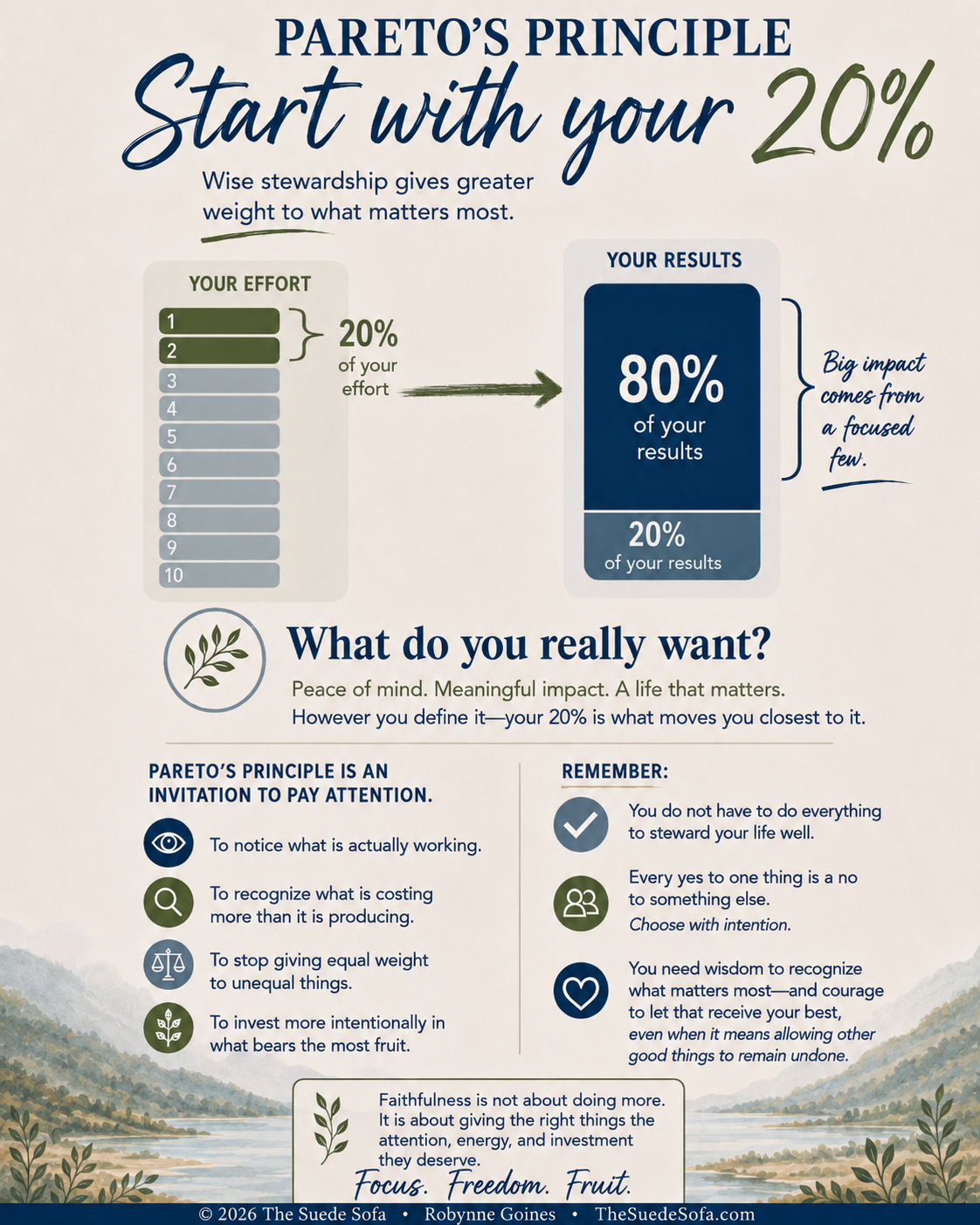
Pareto’s Principle—also known as the 80/20 Rule.
The basic idea is that roughly 80% of results come from 20% of the inputs.
Or, to say it simply:
20% of what you do gives you 80% of your results.
The numbers won’t always divide perfectly into 80 and 20. The point is disproportionate impact:
Not everything contributes equally to the result.
Joseph Juran, who helped popularize the principle, referred to that high-impact minority as “the vital few.”
And that has huge implications for how we steward our lives.
Instead of trying to give equal attention and effort to everything, we can begin asking:
🎯 What result am I actually after?
Once you know the answer, then ask:
⚡ What few actions—the 20%—would produce the greatest share of that result?
Then put more of your time, energy, and attention there.
Sometimes wise stewardship is simply learning to identify the vital few—and investing where your investment will bear the most fruit.
︵‿︵‿︵‿︵
Here’s why this matters so much…
︵‿︵‿︵‿︵
Life is only becoming busier.
We keep adding activities, responsibilities, subscriptions, possessions, information, opportunities, and expectations until nearly every bit of margin has been squeezed out.
And often, we are not overwhelmed because everything is equally important.
We are overwhelmed because we are giving equal weight to unequal things.
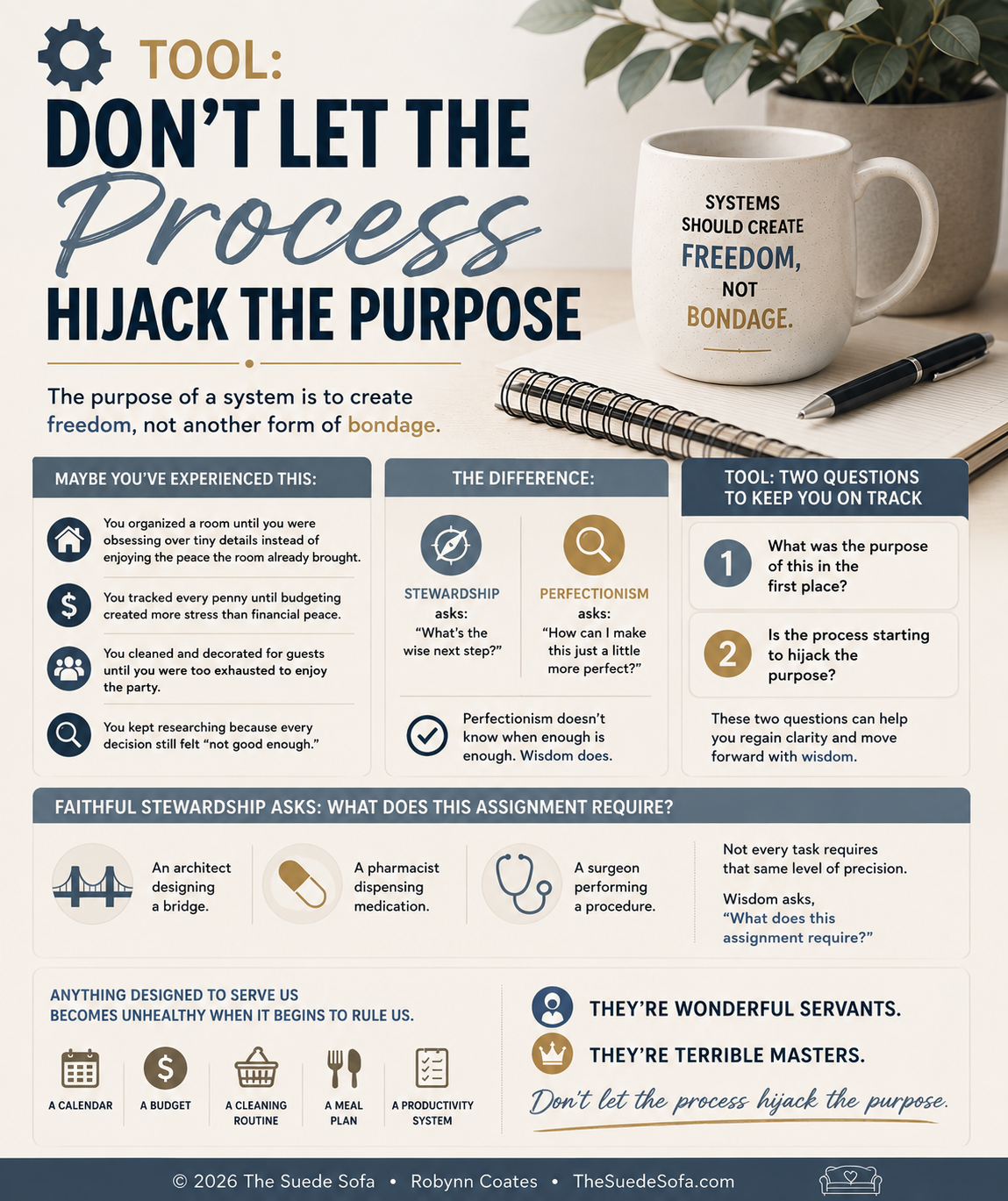
Sometimes we put enormous effort into doing something perfectly when wise stewardship calls for a simpler approach—one that accomplishes what matters most without unnecessary cost.
Ephesians 5:15–17 calls us to live wisely and make the most of our time—to redeem it by understanding and doing what matters most in light of God’s will.
So what might it look like to apply the 80/20 Rule intentionally across the different areas of our lives?
︵‿︵‿︵‿︵
Some ideas…
︵‿︵‿︵‿︵
🙏 SPIRITUAL
What do you really want?
To know God, obey Him, and become more like Christ.
⚠️ What can happen?
We can turn spiritual growth into an ever-expanding list of Bible plans, devotionals, podcasts, books, journaling, memorization, and information.
🎯 What might your 20% be?
Perhaps it is deeply believing and living the truth God is putting in front of you right now.
One passage that becomes life in you can shape you far more deeply than twenty passages you quickly consume but never practice.
The goal is not merely to know more Scripture.
The goal is to allow Scripture to renew your mind, shape your character, and change the way you live.
︵‿︵‿︵‿︵
🧠 PERSONAL
What do you really want?
To feel less scattered and steward your life with greater intention.
⚠️ What can happen?
We build complicated productivity systems, trackers, planners, lists, and routines that create even more cognitive load.
🎯 What might your 20% be?
Identify the few practices that create the greatest amount of clarity and direction.
That might be setting aside time each week to look ahead, deciding what matters most for the next day, or reviewing your priorities before the day begins pulling at you.
A few intentional minutes of planning can prevent hours of scattered attention.
︵‿︵‿︵‿︵
🏋️♀️ PHYSICAL
What do you really want?
To steward your body well—to become healthier, stronger, and better able to do the things your life and assignments require.
⚠️ What can happen?
A simple health goal becomes strength training, cardio, macros, intervals, mobility, supplements, tracking, recovery protocols, and an ever-growing list of things we “should” be doing.
🎯 What might your 20% be?
Identify the one or two foundational practices creating the greatest return—and protect those first.
For one person, that might be completing three strength-training sessions each week.
For another, it may be consistently hitting a protein target.
This does not mean everything else has no value.
It means we stop assuming that every additional benefit is worth its cost.
A practice can be good and still not be necessary for this season.
︵‿︵‿︵‿︵
👨👩👧👦 FAMILY
What do you really want?
Strong, connected relationships with the people you love most.
⚠️ What can happen?
“Be more present” sounds wonderful—but it is so broad that it can become one more impossible standard we feel we should meet all day long.
🎯 What might your 20% be?
Choose a few specific moments when you will give your family your full attention.
When my girls were younger, I called mine “Take Five”:
1️⃣ Be fully present when we first saw each other in the morning. 2️⃣ Be fully present at mealtimes. 3️⃣ Use everyday car rides for connection—no devices or radio. 4️⃣ Give full attention when we reunited after being apart. 5️⃣ Pray before bedtime.
Your five might look completely different.
The point is to turn an important value into a few concrete rhythms you can actually live.
︵‿︵‿︵‿︵
💼 PROFESSIONAL
What do you really want?
To make meaningful progress on your most important work.
⚠️ What can happen?
We give equal attention to email, meetings, small tasks, administrative work, projects, ideas, and requests—until everything feels equally urgent.
🎯 What might your 20% be?
Identify the few priorities that create the greatest amount of meaningful progress.
Put them in order.
Then protect your best time and energy for the work at the top before lower-leverage tasks consume it.
Your calendar can be full while your most important work remains untouched.
Busy and productive are not always the same thing.
︵‿︵‿︵‿︵
💰 FINANCIAL
What do you really want?
Greater financial stability and stewardship.
⚠️ What can happen?
We spend enormous mental energy scrutinizing small purchases while overlooking the few decisions shaping most of our financial life.
🎯 What might your 20% be?
Find the biggest financial lever in your life and address that first.
Maybe it is eliminating a high-interest debt.
Maybe it is automating savings.
Maybe it is finally knowing where your money is going.
The answer will vary.
But the principle remains:
Not every financial decision carries equal weight.
︵‿︵‿︵‿︵
🌿 REST & RECHARGE
What do you really want?
To actually feel restored.
⚠️ What can happen?
We fill our downtime with activities that distract us without replenishing us.
🎯 What might your 20% be?
Identify the one or two activities that consistently leave you feeling genuinely more restored—and make room for those first.
Not everything we do to escape helps us recover.
Learn the difference between what distracts you and what restores you.
︵‿︵‿︵‿︵
❤️ PEOPLE
What do you really want?
Meaningful relationships and a life characterized by love.
⚠️ What can happen?
We assume loving people means giving everyone equal time, access, and relational depth.
But our capacity is limited.
🎯 What might your 20% be?
Identify the relationships God has most clearly entrusted to you and make sure those relationships receive intentional investment.
The 80/20 Rule does not mean eliminating people or reducing relationships to percentages.
Love can be expansive while depth remains selective.
Strengthen your core relationships first.
︵‿︵‿︵‿︵
🏠 HOME & ORDER
What do you really want?
A home that feels peaceful, functional, and reasonably in order.
⚠️ What can happen?
We turn “getting the house back in order” into organizing every drawer, cleaning every corner, and completing every deferred project—while unintentionally neglecting the people and priorities the home is meant to serve.
🎯 What might your 20% be?
Ask:
What few things would make the entire space feel substantially better?
Maybe it is clearing the kitchen counters.
Maybe it is removing everything that needs to leave the house.
Maybe it is cleaning out the refrigerator, pantry, car, or garage.
Your 20% will not necessarily look like someone else’s.
The question is:
Which few actions restore the greatest amount of order?
︵‿︵‿︵‿︵
Protect the Vital Few
︵‿︵‿︵‿︵
Identifying the vital few is only part of wise stewardship.
Once you know what matters most, you have to protect it from being crowded out by everything else.
Because every “yes” carries a “no” with it.
Every yes to one use of your time, energy, attention, or resources is also a no to something else.
That is why wise stewardship requires more than asking:
“Is this good?”
It requires asking:
“Is this the best place for what God has entrusted to me right now?”
Some things deserve greater investment.
Some things can be simplified.
Some can be delegated, reduced, postponed, or released.
And some things may be genuinely good—but not valuable enough to carry in this season.
Pareto’s Principle is ultimately an invitation to pay attention:
👀 Notice what is actually working. 🔎 Recognize what is costing more than it is producing. ⚖️ Stop giving equal weight to unequal things. 🌱 Invest more intentionally in what bears the most fruit.
You do not have to do everything to steward your life well.
You need wisdom to recognize what matters most—and courage to let that receive your best, even when it means allowing other good things to remain undone.
Faithfulness is not giving everything your maximum effort.
It is giving the right things the attention, energy, and investment they deserve.
One of my favorite verses has long been Joshua 1:9:
“Have I not commanded you? Be strong and courageous. Do not be afraid; do not be discouraged…”
I love those words.
And while it’s important to read Scripture in context—to understand:
👤 Who God was speaking to 📍 What was happening 🎯 What He was calling that person to do
✨ That doesn’t mean there is nothing there for us.
Romans 15:4 reminds us:
“For everything that was written in the past was written to teach us, so that through the endurance taught in the Scriptures and the encouragement they provide we might have hope.”
Joshua had a very specific assignment.
So do we.
And while ours may look very different from his—and may feel incredibly ordinary, unexciting, or even mundane—faithfulness to our own assignment is still going to require courage.
Sometimes courage looks big.
But often, it looks surprisingly ordinary.
It can look like:
🌱 believing God is still at work when you cannot yet see what He is doing 🤝 admitting you were wrong and making it right 💬 having the difficult conversation you would rather avoid 🧭 doing the right thing when the easier thing would cost you less 🚫 refusing to let fear make your decisions for you 🏃 refusing to let discouragement convince you to quit 🌤️ holding on to hope in a world that can feel incredibly fragile 🔄 beginning again after disappointment 🪴 staying faithful when there is very little applause 🛑 saying no when pressure is telling you to say yes ➡️ saying yes when fear is telling you to stay small 🤲 continuing to love people without surrendering truth 🗣️ standing for truth when it would be easier to stay silent 👣 taking the next faithful step when you don’t get to see the whole road
The New Testament carries that same call:
“Be on your guard; stand firm in the faith; be courageous; be strong. Do everything in love.” — 1 Corinthians 16:13–14
I especially love that last part.
Courage and love belong together.
❌ Biblical courage isn’t swagger. ❌ It isn’t recklessness. ❌ It isn’t pretending we never feel afraid or discouraged.
✅ It is refusing to let fear or discouragement have the final word. ✅ It is trusting God enough to faithfully do what He has put in front of us—even when fear comes along for the ride.
It is trusting God enough to faithfully do what He has put in front of us—even when fear comes along for the ride.
Your assignment may never look dramatic.
It may look like a thousand small, ordinary acts of faithfulness.
But somewhere along the way, it will almost certainly ask you to be brave.
➡️ Be strong and courageous. ➡️ Do not be afraid. ➡️ Do not be discouraged. ➡️ Stand firm. ➡️ And do it all in love.