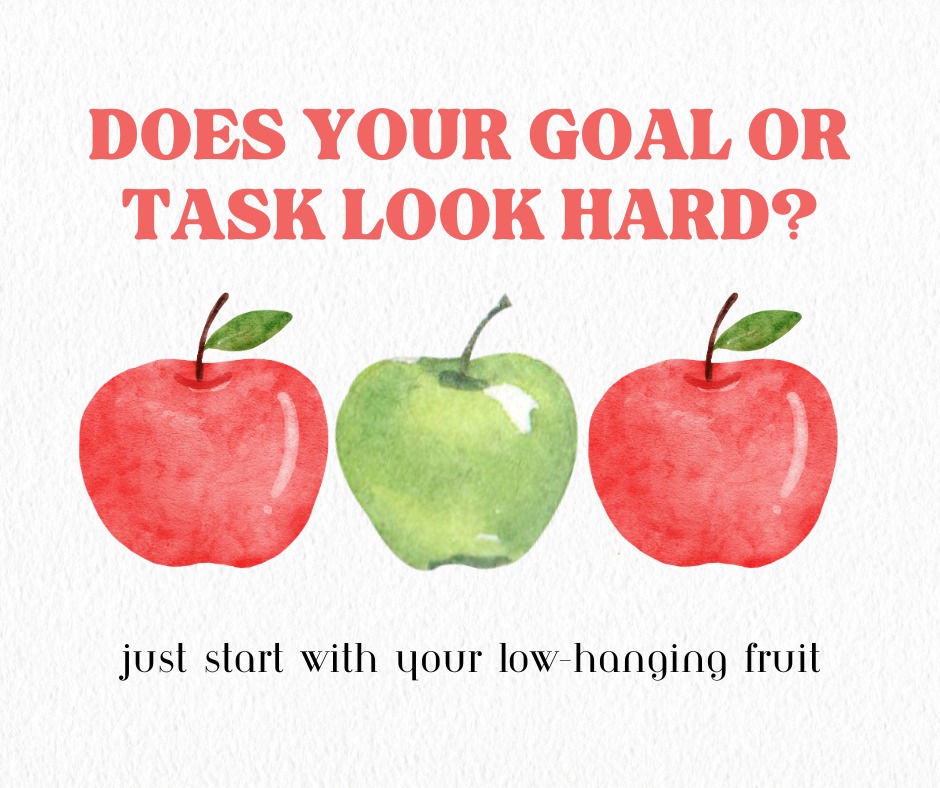
In my last post, I shared how the idea for The Low-Hanging Fruit Framework™ came to life—and how that simple insight began changing everything for me.
Here’s a little more of the backstory 
For years, I kept failing at my goals—and I couldn’t figure out why. Looking back, I realized I’d been ignoring a major principle: little things matter—and they matter a lot.
My mistake? A perfectionist, all-or-nothing mindset. I only set big goals, as small steps felt unexciting and insignificant. But once I began renewing my mind with this truth, everything changed—not just spiritually, but practically too.
 “If you are faithful in little things, you will be faithful in large ones.” —Luke 16:10
God’s truth reaches every part of us—body, mind, and spirit. The same principle of being faithful in little things is reflected in how our brains grow and change through small, repeated actions.
 What’s Happening in Your Brain
As I began studying how the brain works on a neurological level, I learned that its primary job is to keep you safe and conserve energy—not necessarily to help you reach long-term goals like getting fit or building new habits.
Your brain prefers predictability over change. So when you set a big, dramatic goal (like losing weight by cutting out favorite foods or completely overhauling your routine), your brain can interpret that level of change as a potential stressor.
At first, you might push through on motivation alone—but eventually, your body pushes back:
 Hunger hormones rise.
Willpower fades.
And your brain gently nudges you back toward “safety” (what’s familiar).
That’s why so many diets, resolutions, and “all-or-nothing” efforts fail.
But here’s the good news: your brain doesn’t resist small, doable actions. Tiny wins fly under the radar, feel safe, and actually release dopamine—your brain’s “reward chemical”—which makes you want to keep going.
That’s why the Low-Hanging Fruit Framework™ works so powerfully—it aligns with how your brain was designed. 
Small, consistent wins build confidence, momentum, and long-term change—without triggering resistance.
 It’s amazing how modern research keeps confirming what God’s Word has said all along. In this case, small, faithful steps lead to lasting transformation. Science simply reveals the brilliance of His design.
 How to Find Your Low-Hanging Fruit
Here’s how to spot an action that will actually move the needle.
Use the 4-S.T.E.P. Low-Hanging Fruit Framework™ by identifying an action you can literally check the box on—and make sure it checks all four boxes:
 S = Simple – A clear “yes” or “no.” You either did it or you didn’t. Period.
T = Time-Sensitive – Something you can start immediately.
E = Easy – Simple in both thought and execution.
P = Progressive – Something you can scale over time.
Btw, it should feel so simple you’re tempted to write it off as insignificant—but don’t. That’s how God designed growth to work—spiritually and neurologically—one small, faithful step at a time. A little seed you plant that brings a big harvest.
Need Some Ideas to Get Started?
Relationship with God
Read one verse with your morning coffee
Pray a short prayer of thanksgiving
 Marriage, Parenting, & Relationships
Say “I love you” before bed
Send one encouraging text
 Health & Fitness
Do 5 lunges
Take a walk around the block
 Finances
Check account balances daily
Track expenses from the last 24 hours
Start with your seed and over time you’ll be able to scale and grow.
 Action Step for Today
What’s the ONE habit that would make the biggest difference in your life?
 Once you know it, identify your Low-Hanging Fruit—the small, faithful action you can start today using the 4-S.T.E.P. Low-Hanging Fruit Framework™.
Remember: Small, faithful actions done consistently create big transformation over time.
And here’s an encouragement for you as you begin these small steps from Zechariah 4:10 (NIV):
“Do not despise these small beginnings, for the Lord rejoices to see the work begin.”
 The Suede Sofa Blog