Have you ever been somewhere people were friendly—but you still didn’t feel like you belonged?
During a conversation with one of my daughters about friendship, I mentioned that someone seemed friendly.
She said, “Mom, you can be friendly but not welcoming.”
💡 Light bulb.
I’d never quite thought about it that way, but immediately I could see the distinction.
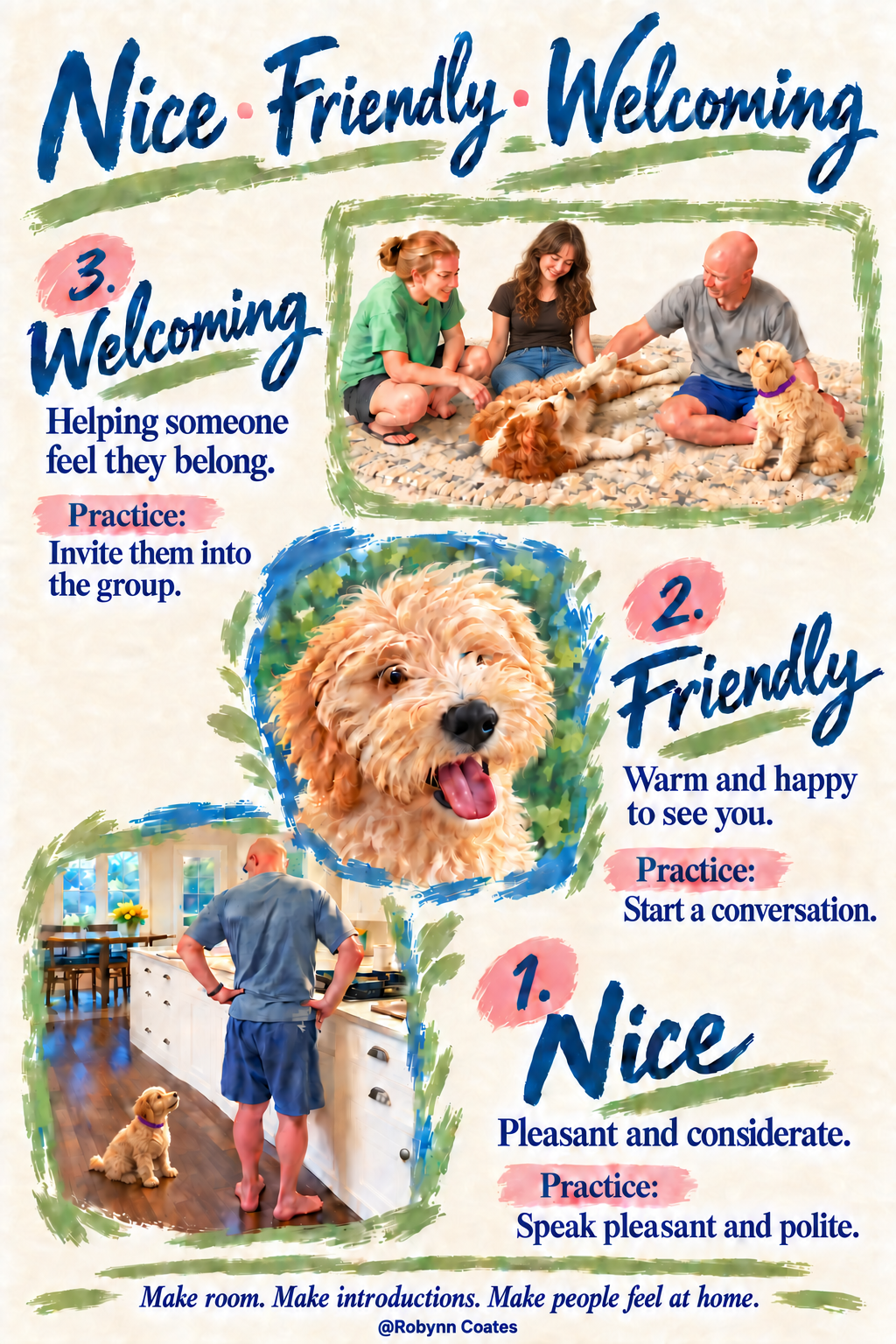
1️⃣ Nice—Responding pleasantly.
2️⃣ Friendly—Engaging warmly.
3️⃣ Welcoming—Helping people feel at home.
All good—but each takes us a little further into relationship.
And because my family’s dog Buddy has given us a picture of all three, I’ll let him help explain. 🐶😊
────────── ✦ ──────────
🐶 Level 1: Nice
────────── ✦ ──────────
When we went to pick out our puppy, we had a plan.
We were getting a girl.
Her name would be Zoe.
She would be cinnamon-colored.
And we had already bought the pink accessories.
The crate. The collar. The bed.
Everything. Pink. 😂
Then we arrived to find puppies everywhere, jumping all over us.
How were we supposed to choose?
But one little puppy sat quietly, looking up at us so sweetly.
(Picture that sweet look Buddy is giving Scott in the kitchen photo.)
Scott said, “I think we should pick that dog right there.”
That dog was Buddy.
A boy.
Yellow.
Definitely not Zoe. 😂
There was something about his gentle little presence that drew us to him.
That’s our little picture of nice: pleasant and considerate.
With people, nice might mean that when you speak to them, they respond kindly. Their words and tone are courteous. They treat you well.
And that matters.
But you might not know that until you approach them.
You may feel a little uncertain about starting a conversation. Am I interrupting? Do they want to talk?
Then you do—and they’re perfectly nice.
They respond kindly, but they haven’t necessarily given you an invitation to engage.
────────── ✦ ──────────
🐶 Level 2: Friendly
────────── ✦ ──────────
Come to our door, and you’ll meet another side of Buddy.
He comes running.
He’s happy to see you.
He may even jump on you to make sure you know it. 😂
Buddy doesn’t leave you wondering whether your arrival is good news.
Friendly gives you a signal: “I’m glad to see you.”
With people, that might look like a warm smile, coming over to say hello, starting a conversation, asking a question, or showing interest in the answer.
You’re engaging.
You’re helping the other person know you’re glad they’re there.
────────── ✦ ──────────
🐶 Level 3: Welcoming
────────── ✦ ──────────
Then there’s taking that warmth one step further: making room for people and helping them feel they belong.
Buddy loves it when he hears our neighborhood dog Red’s bark at the front door. Red makes regular visits, and Buddy greets him with enthusiastic barking and jumping. 😂
Then Buddy turns his attention to us, barking as if to announce, “Red’s here! We need cheese! Let’s take care of our guest!”
And as you can see in the photo, Red likes to settle in and stay awhile. There’s room for him, too—in the treats, the attention, and whatever we’re doing.
Buddy wants Red to know he’s 💯 part of the clan.
That’s a little picture of welcoming: going beyond being happy someone arrived to making room for them to be part of things.
Our human version takes a little more intention.
Welcoming means making room in your space, your attention, or what you’re doing—and helping someone feel at home, like they belong.
Think of a restaurant hostess. A friendly hostess might smile and say, “Hi! How are you?”
A welcoming hostess takes it further: “Come on in. Let’s get you comfortable. I have a table right over here.”
They notice what you need and help you settle in.
You don’t just feel greeted. You feel wanted and cared for.
Or think about walking into a room where you don’t know anyone.
Everyone else seems to know where to sit, who to talk to, and how things work.
You’re trying to look comfortable while quietly wondering what to do with yourself.
Then someone notices.
They come over and say, “Come sit with us.”
➡️ They introduce you to the others.
➡️ They help you follow—and join—the conversation.
➡️ They stay attentive after the introduction.
You remember the relief of someone seeing you on the edge and bringing you in.
This feels like rare air to me. It takes attention and intention to help someone feel they belong. I haven’t mastered it, but I’m working on it.
And we can practice in simple ways:
➡️ Give someone your full attention.
➡️ Offer the seat beside you.
➡️ Bring someone into the conversation.
Notice when our familiar circles become closed circles. We can enjoy our people and still make room for another person to become one of them.
1️⃣ Nice says, “I’ll treat you kindly.”
2️⃣ Friendly says, “I’m glad to see you.”
3️⃣ Welcoming says, “You belong here.”
I’m grateful my daughter helped me see the difference. It’s given me a question to carry into the rooms I enter:
Who could I help feel at home here?
As we explore the different people who make up a POSSE, each post will include practical ways to welcome them—or tend the relationship you already share.
Look for one step you could take toward someone.
A conversation. An invitation. A little follow-through.
That’s how we move from a friendly hello to a genuine welcome. 🌱


Leave a Reply